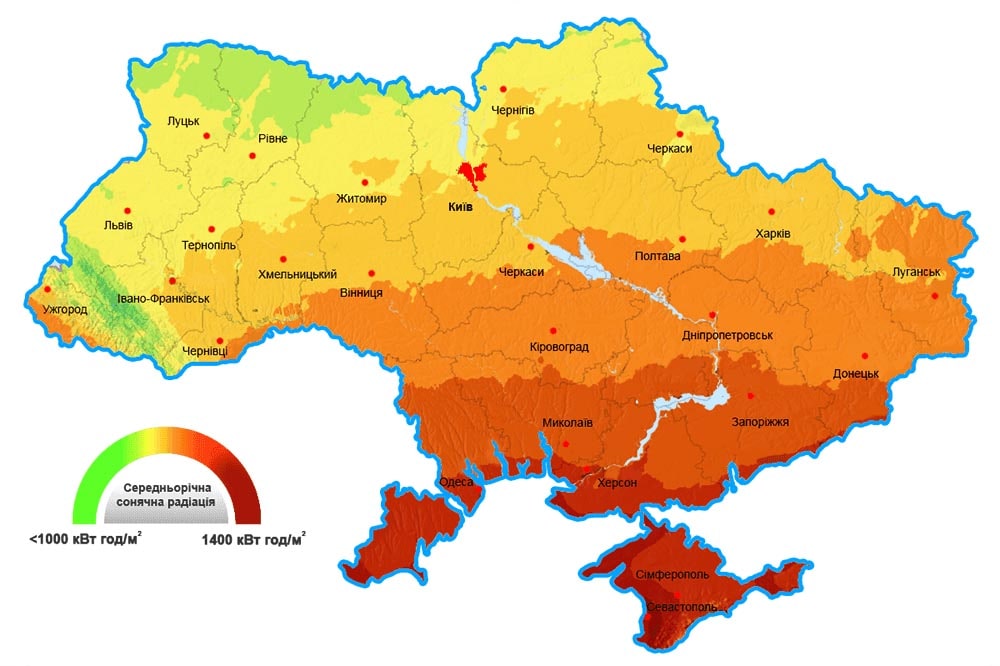
If you own solar panels or are considering installing them, understanding this concept is critical. Peak solar hours allow you to maximize the efficiency of your solar panels and estimate their potential energy production.
In this article, we’ll cover the key aspects of peak solar hours:
- What are peak solar hours?
- Average daily peak solar hours for different regions of Ukraine
- How to calculate peak solar hours
We’ll provide all the information you need, but you don’t have to perform complex calculations yourself. Our solar energy experts will help you with this for free.
What are peak hours?
Peak hours are the amount of sunlight received by a given location. A typical peak hour is 1,000 watts (W) of energy per square meter for one hour. This is essentially a lot of direct, intense sunlight during a short period of midday.
It’s important not to confuse peak hours with total daylight hours—they are not the same thing. Daylight hours are the time between sunrise and sunset. Peak hours are the period when the sun’s intensity is sufficient for highly efficient solar energy generation.
Factors Affecting Peak Sunshine Hours in Ukraine
Several factors influence the calculation of peak sunshine hours:
– Sun angle
The Earth’s rotation changes the angle at which sunlight strikes the surface throughout the day. This angle also depends on your geographic location and the time of year. Sunlight is most intense when the sun is directly overhead, resulting in the highest energy production at this time.
– Latitude
Your distance from the equator is a key factor in calculating peak solar intensity. Regions closer to the equator receive more direct sunlight throughout the year.
In Ukraine, southern regions such as Crimea and the Odesa region receive more peak solar hours than northern regions such as the Chernihiv and Kyiv regions.
– Time of year
The tilt of the Earth’s axis causes the sun’s angle to change throughout the year. This causes seasonal variations, so one should expect variations in peak hours of sunshine from month to month.
For example, the sun is highest in the sky during the summer solstice, leading to more intense peak hours of sunshine in certain locations. In Ukraine, the peak occurs in June-July.
– Weather conditions
Cloud cover, atmospheric conditions, and even pollution affect the amount of sunlight reaching the Earth’s surface. Regions with a high number of cloudy days have fewer peak sunshine hours than those with predominantly clear, sunny skies.
In Ukraine, western regions such as the Lviv and Zakarpattia oblasts may have fewer peak sunshine hours due to frequent rainfall and cloud cover compared to eastern regions such as the Kharkiv and Dnipropetrovsk oblasts.
Why are peak sun hours so important when it comes to solar panels?
– Accurate Energy Production Estimates
Manufacturers rate solar panels based on their efficiency in converting sunlight into electricity. To estimate how much energy your solar panels can produce, you need to consider the peak sun hours in your location, taking into account the factors above. Accurate estimates help you make informed decisions about the system and the size of panels you need to purchase to meet your energy savings standards.
– Solar System Size
Peak sun hours play a crucial role in determining the appropriate size of solar panel system to meet your energy needs. For example, a system that is too small will likely not generate enough energy to meet your needs. Meanwhile, a system that is too large may generate excess energy that you don’t use.
– Assessing Project Viability
For homeowners and businesses considering solar projects, understanding the peak sun hours in your location is vital when assessing the potential return on investment.
– Optimal Panel Placement
Understanding peak solar hours helps you find the best location for solar panels. Specifically, you’ll learn the ideal angle and orientation for maximizing energy production. Properly positioning solar panels increases their efficiency and reduces long-term energy loss. Of course, it also saves money.
How to calculate peak sunshine hours in Ukraine
- Collect solar radiation data: Solar radiation is the amount of solar energy reaching a given area per unit of time. This data is typically measured in watts per square meter (W/m²). You can find solar radiation data from reliable sources, such as NASA or local meteorological services.
- Choose a standard: Select a solar radiation value that represents the minimum level of sunlight required for efficient energy production. The standard value is 1000 W/m², which is the optimal amount of solar energy received in clear, direct sunlight.
- Use the peak sunshine calculator: Now calculate peak sunshine hours. Divide the total solar energy received in one day, in watt-hours per square meter (Wh/m²), by the reference irradiance in W/m².
Formula: Peak Sunshine Hours = Total Solar Energy (Wh/m²) / Reference Irradiance (W/m²)
Let’s assume you have a total solar energy of 8000 Wh/m² for one day and a reference irradiance of 1000 W/m²:
- Peak solar hours = 8000 Wh/m² ÷ 1000 W/m²
- Peak solar hours = 8 hours
In this example, your location receives eight hours of peak sun for that day. Keep in mind that peak sun hours vary across Ukraine, so be sure to consider all the details when determining peak sun hours!
Knowing peak sun hours can help you decide whether investing in a solar system is worth it! It can also help you determine the ideal system size for your home or business. You can also determine the best panel angle for optimal performance.
Of course, taking all the factors into account and making accurate calculations specific to a specific location can be quite challenging. This is where solar energy experts come in. Using peak sun hours, we can help you unlock the full potential of solar energy.