A solar panel doesn’t produce the rated power because this power is measured under laboratory conditions (STC), but in reality, it operates under different, harsher real-world conditions (NOCT).
One of the most common Google queries is: why doesn’t a solar panel produce the rated power?
A 450-watt panel may indeed never produce 450 watts in real life – and this isn’t a defect.
The reason is that there’s a difference between the rated power and the actual output.
What is the actual power of a solar panel?
The actual power of a solar panel is the power it produces under operating conditions, not in a laboratory.
This indicator is important for calculating solar power plant design, assessing payback, and forecasting generation.
STC vs NOCT - the difference in simple words
This is one of the key points to understand.
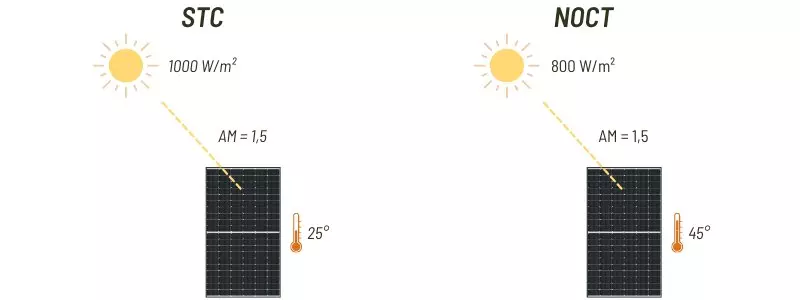
STC (Standard Test Conditions) are ideal laboratory conditions:
- 1000 W/m²
- 25°C
- no losses
here the panel shows maximum power
NOCT (Nominal Operating Cell Temperature) are real-world conditions:
- ~800 W/m²
- ~45°C panel
- natural losses
here you can see actual generation
The main difference between STC and NOCT:
STC is maximum
NOCT is reality
Solar Panel Comparison Longi vs. Jinko vs. TCL
| Brand | STC | NOCT |
|---|---|---|
| LONGi | 450 | 335–340 |
| Jinko | 450 | 330–338 |
| TCL | 450 | 340–350 |
All panels have the same nominal power.
But the actual power output of a solar panel varies.
The difference can be 10–15 watts per module.
For a large station, this is a significant increase in power generation.
How to read a solar panel datasheet
To correctly read a solar panel datasheet, you need to look beyond the STC.
What’s important:
- STC – for comparison
- NOCT – for reality
- Temperature Coefficient
- Degradation
If generation is calculated only by the STC, it means real-world conditions are not fully accounted for.
A solar panel doesn’t “lose” power. It simply doesn’t work in the lab.
STC is a comparison number
NOCT is a real-world number